> For the complete documentation index, see [llms.txt](https://docs.uptiq.ai/llms.txt). Markdown versions of documentation pages are available by appending `.md` to page URLs; this page is available as [Markdown](https://docs.uptiq.ai/ai-workbench-qore/control-center/evals/human-review.md).
# Human Review
Review and resolve low-confidence evaluation tasks.
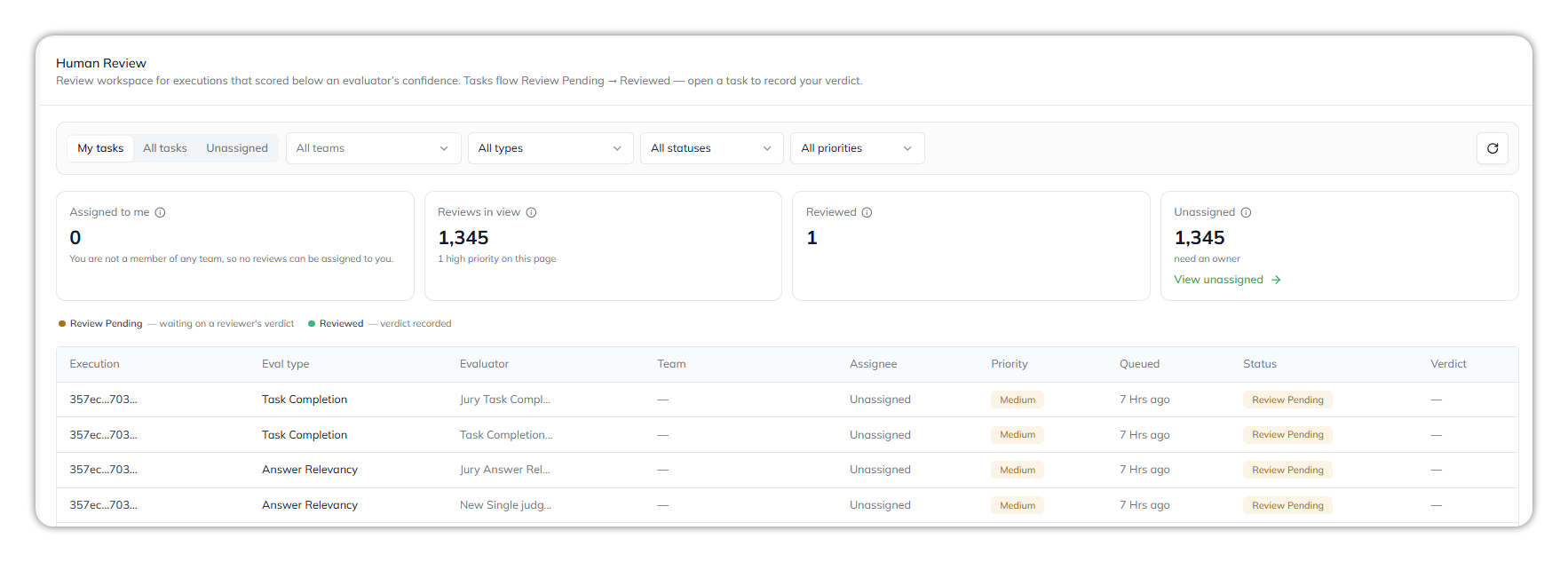
Human Review is where reviewers decide executions that score below evaluator confidence thresholds. Open **Control Center → Evals → Human Review**.
Tasks move from **Review Pending** to **Reviewed** after a reviewer records a verdict.
Human Review is the queue for tasks awaiting a reviewer verdict.
Use **My tasks**, **All tasks**, and **Unassigned** to switch queues. Filter by team, type, status, or priority.
The queue summary shows **Assigned to me**, **Reviews in view**, **Reviewed**, and **Unassigned**. Select **View unassigned** to open unassigned tasks.
Each task shows:
* **Execution**, **Eval type**, and **Evaluator** that flagged it
* **Team** and **Assignee** responsible for the task
* **Priority**, **Queued** time, **Status**, and recorded **Verdict**
Open a task, record a verdict, and move it to **Reviewed**.
The open task's evaluation summary shows the judge's reasoning and, when the judge gave any, its **Evidence**: up to three points, each citing something the agent did or failed to do and whether it raised or lowered the score.
{% hint style="info" %}
### Assignments use teams
Human Review assigns tasks through teams, not directly to individuals. A reviewer without a team has no assigned tasks.
Configure teams in [Admin](/ai-workbench-qore/control-center/admin/teams.md).
{% endhint %}
{% hint style="info" %}
Each evaluator has its own confidence threshold. For example, one evaluator can route scores below `67%`, while another routes scores below `100%`.
{% endhint %}
***
{% columns %}
{% column width="83.33333333333334%" %}
Maintained by Abhishek Paul AI-assisted, human-approved
{% endcolumn %}
{% endcolumns %}
---
# Agent Instructions
This documentation is published with GitBook. GitBook is the documentation platform designed so that both humans and AI agents can read, navigate, and reason over technical content effectively. Learn more at gitbook.com.
## Querying This Documentation
If you need additional information that is not directly available in this page, you can query the documentation by asking a question.
Perform an HTTP GET request on the following URL with the `ask` and `goal` query parameters:
```
GET https://docs.uptiq.ai/ai-workbench-qore/control-center/evals/human-review.md?ask=&goal=
```
`ask` is the immediate question: it should be specific, self-contained, and written in natural language.
`goal` is what the user is ultimately trying to achieve, the reason they need the answer. Sharing it helps GitBook give you a better, more relevant answer. A goal is most helpful when it describes the outcome the user wants rather than restating the question. For example, with `ask=how do I create an API token`, a goal like `automate deployments from our CI pipeline` lets GitBook tailor the answer to that use case.
The response will contain a direct answer to the question and relevant excerpts and sources from the documentation.
Use this mechanism when the answer is not explicitly present in the current page, you need clarification or additional context, or you want to retrieve related documentation sections.