> For the complete documentation index, see [llms.txt](https://docs.uptiq.ai/llms.txt). Markdown versions of documentation pages are available by appending `.md` to page URLs; this page is available as [Markdown](https://docs.uptiq.ai/ai-workbench-qore/console/app-builder/creating-and-importing-apps.md).

# Importing apps

Create apps from prompts, packages, repositories, or your own IDE.

There are four ways to get an app into App Builder:

* Describe a new one from a prompt
* Import a project you already have
* Bring in a Git repository
* Connect your own IDE

This page covers each.

## Create a new app from a prompt

On the App Builder home, describe the app you want to build in the **Describe the app you want to create…** box, choose what kind of app it is, pick the model that builds it, and start the build. Qore opens the [app workspace](/ai-workbench-qore/console/app-builder/app-workspace.md) and works through your request. If you'd rather not start from scratch, pick one of the starter templates offered beneath the prompt.

<figure><img src="https://1326225582-files.gitbook.io/~/files/v0/b/gitbook-x-prod.appspot.com/o/spaces%2F0qmgQjJ5aArDTj2ACFHG%2Fuploads%2Fgit-blob-097424e10a66f71a5b21aae357602ac2049cef70%2Fqore_app-builder_studio-app-builder-import-an-existing-app-new-app_rounded_shadow.png?alt=media" alt="The app creation prompt box, with Web/Mobile target and model selection"><figcaption><p>Describing a new app and choosing its target and model.</p></figcaption></figure>

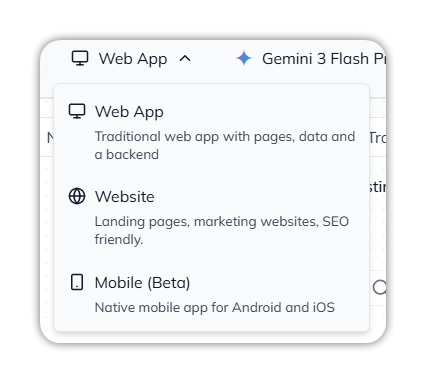
The app type menu, which reads **Web App** by default, offers three types:

* **Web App** — Traditional web app with pages, data and a backend.
* **Website** — Landing pages, marketing websites, SEO friendly.
* **Mobile (Beta)** — Native mobile app for Android and iOS.

<figure><img src="https://1326225582-files.gitbook.io/~/files/v0/b/gitbook-x-prod.appspot.com/o/spaces%2F0qmgQjJ5aArDTj2ACFHG%2Fuploads%2Fgit-blob-cc4275ef342e83a402bc88d0eab39ce5abf69917%2Fqore_app-builder_how-to-target-menu_rounded_shadow.png?alt=media" alt="The app type menu open, listing Web App, Website, and Mobile (Beta), each with a one-line description"><figcaption><p>The three app types.</p></figcaption></figure>

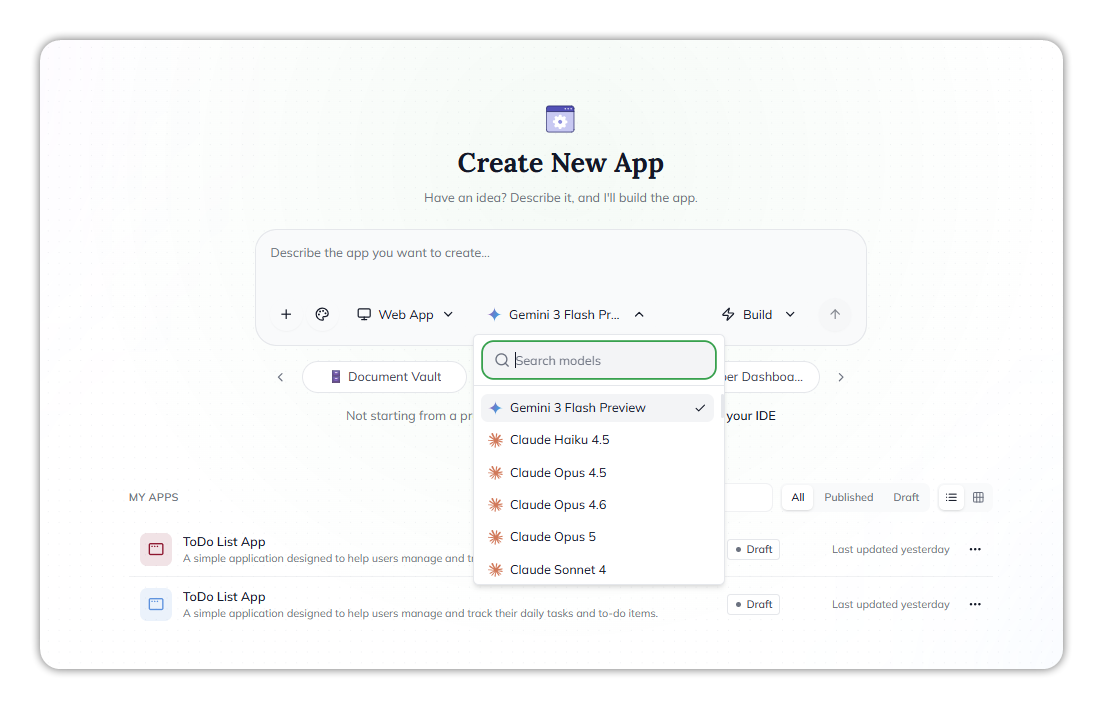
To change the model, open the model menu beside the app type, which shows the current model, such as **Gemini 3 Flash Preview**. Each model carries its provider's logo: Claude for Anthropic, Gemini for Google, and OpenAI. A model from any other provider shows a generic sparkle icon. When the list holds more than six models, a **Search models** box at the top lets you type part of a name to narrow it. The current model is ticked.

<figure><img src="https://1326225582-files.gitbook.io/~/files/v0/b/gitbook-x-prod.appspot.com/o/spaces%2F0qmgQjJ5aArDTj2ACFHG%2Fuploads%2Fgit-blob-45937a64677f46c12ffd405a642f9f40bcc517d3%2Fqore_app-builder_create-new-app-model-search_rounded_shadow.png?alt=media" alt="The Create New App prompt with the model menu open: a Search models box above a list of models, each with its provider&#x27;s logo, and Gemini 3 Flash Preview ticked"><figcaption><p>Search the model menu, and see each model's provider at a glance.</p></figcaption></figure>

## Import an existing app

Choose **Import an existing app** to bring in an app you already have. You can supply it three ways:

* **Upload a package or project** — drag in, or select, a ZIP file up to 500 MB.
* **GitHub** — import a repository.
* **GitLab** — import a project.

<figure><img src="https://1326225582-files.gitbook.io/~/files/v0/b/gitbook-x-prod.appspot.com/o/spaces%2F0qmgQjJ5aArDTj2ACFHG%2Fuploads%2Fgit-blob-2213490a2da56f85fc7a37ceb5dbf7f2e3f5f8fd%2Fqore_app-builder_studio-app-builder-import-an-existing-app_rounded_shadow.png?alt=media" alt="The Import an existing app dialog, with Upload, GitHub, and GitLab options"><figcaption><p>The three ways to import an existing app.</p></figcaption></figure>

{% hint style="info" %}
A Qore **Platform package** is restored as-is — it comes back exactly as it was. Anything else — a Git repository, or a project exported from Lovable, v0, Bolt, or Figma Make — is **converted** into a Platform app. Expect a conversion step, not a byte-for-byte restore, for non-Platform sources.
{% endhint %}

### Import from GitHub

Choose **GitHub**, then:

{% stepper %}
{% step %}

#### Pick the connected account

{% endstep %}

{% step %}

#### Choose a Repository

{% endstep %}

{% step %}

#### Choose a Branch

This only becomes available once you've selected a repository.
{% endstep %}

{% step %}

#### Select Continue

Import that repository and branch.
{% endstep %}
{% endstepper %}

<figure><img src="https://1326225582-files.gitbook.io/~/files/v0/b/gitbook-x-prod.appspot.com/o/spaces%2F0qmgQjJ5aArDTj2ACFHG%2Fuploads%2Fgit-blob-28adf5eaaaed370cdf69174f6f72eae92a1de911%2Fqore_app-builder_studio-import-an-existing-app_rounded_shadow.png?alt=media" alt="The App Builder home, with the app creation prompt and the option to import an existing app"><figcaption><p>Starting a new app or importing an existing one from App Builder's home.</p></figcaption></figure>

<figure><img src="https://1326225582-files.gitbook.io/~/files/v0/b/gitbook-x-prod.appspot.com/o/spaces%2F0qmgQjJ5aArDTj2ACFHG%2Fuploads%2Fgit-blob-dcdfc72d151e089f0f9d39905fc224626ee7e09e%2Fqore_app-builder_studio-app-builder-import-an-existing-app-git-hub_rounded_shadow.png?alt=media" alt="The GitHub import flow, with account, repository, and branch selection"><figcaption><p>Importing a repository from GitHub.</p></figcaption></figure>

### Import from GitLab

Choose **GitLab**. If your GitLab account isn't connected yet, select **Connect GitLab** first, authorize Qore, and return to the tab to browse your projects.

{% hint style="info" %}
GitHub lets you select a repository and branch right away. GitLab requires an account connection before you can browse projects.
{% endhint %}

<figure><img src="https://1326225582-files.gitbook.io/~/files/v0/b/gitbook-x-prod.appspot.com/o/spaces%2F0qmgQjJ5aArDTj2ACFHG%2Fuploads%2Fgit-blob-4fd5e01ff9cb15a33754a7717649001ca4430aa8%2Fqore_app-builder_studio-app-builder-import-an-existing-app-git-lab_rounded_shadow.png?alt=media" alt="The GitLab import flow, with project selection"><figcaption><p>Importing a project from GitLab.</p></figcaption></figure>

{% hint style="info" %}
Connecting GitHub or GitLab grants Qore access to your source account. Connect only the account you intend to import from.
{% endhint %}

## Build from your IDE

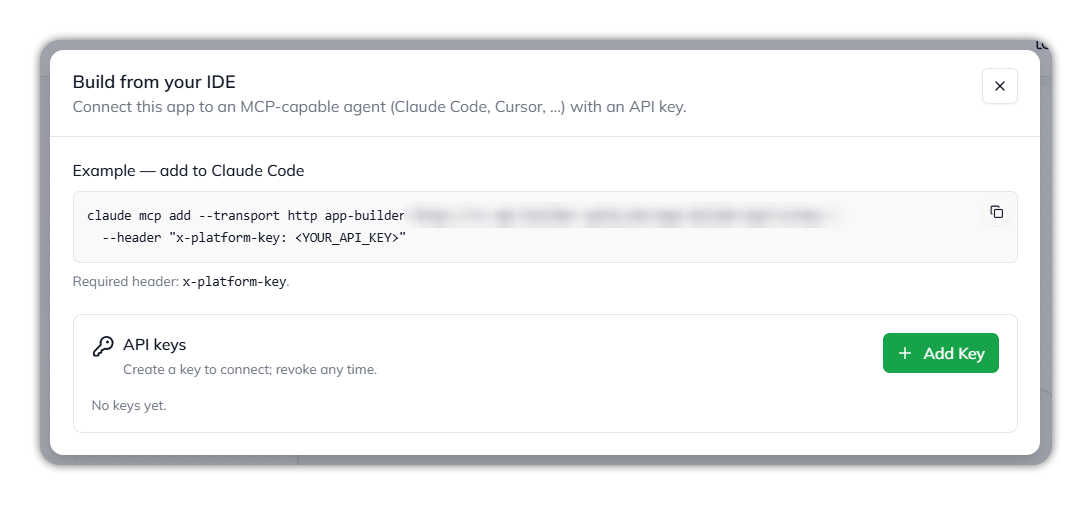
Choose **Build from your IDE** to connect an app to an MCP-capable coding agent — for example Claude Code or Cursor — so you can build it from your own editor.

<figure><img src="https://1326225582-files.gitbook.io/~/files/v0/b/gitbook-x-prod.appspot.com/o/spaces%2F0qmgQjJ5aArDTj2ACFHG%2Fuploads%2Fgit-blob-103184cd55ae1c4f8ff77280d951e80b16aef91e%2Fqore_app-builder_how-to-build-from-your-ide_rounded_shadow.png?alt=media" alt="The Build from your IDE dialog: an example claude mcp add command for Claude Code with the server address blurred, the required x-platform-key header, and an API keys section with Add Key and No keys yet"><figcaption><p>The Build from your IDE dialog.</p></figcaption></figure>

{% stepper %}
{% step %}

#### Create an API key

In the **Build from your IDE** dialog, under **API keys**, select **+ Add Key** and name it. The key connects your editor to this app. Each key shows its **Name**, a masked value, and a **Status**, and can be revoked at any time with **Revoke**. Before you've made one, the list reads *No keys yet.*
{% endstep %}

{% step %}

#### Add the App Builder MCP server to your editor

Copy the connection command and run it in your coding agent, replacing `<YOUR_API_KEY>` with the key you created. The endpoint is `<BASE_URL>/app-builder/api/v1/mcp` and every request must carry the header `x-platform-key`. Replace `<BASE_URL>` with the Qore API host your organization uses — confirm it with your platform administrator, as it differs by deployment.

{% code title="Add the App Builder MCP server (Claude Code)" overflow="wrap" %}

```bash
claude mcp add --transport http app-builder <BASE_URL>/app-builder/api/v1/mcp \
  --header "x-platform-key: <YOUR_API_KEY>"
```

{% endcode %}
{% endstep %}

{% step %}

#### Build from your editor

With the server connected, your coding agent can build this app directly from your IDE.
{% endstep %}
{% endstepper %}

{% hint style="warning" %}
An API key is a credential — it grants an external tool access to build this app. Store it securely, and **Revoke** any key you no longer use.
{% endhint %}

## Why this matters

* You can start an app however suits you — a prompt, a package, a repository, or your own editor.
* What you import determines what you get: a Platform package restores exactly; everything else is converted.

## Related

{% content-ref url="/pages/bc7662d99efc00ab94438c3b32248b84a7af247f" %}
[App Workspace](/ai-workbench-qore/console/app-builder/app-workspace.md)
{% endcontent-ref %}

***

{% columns %}
{% column width="83.33333333333334%" %}

<p align="right"><em>Maintained by</em> <mark style="color:green;">Abhishek Paul</mark><br><code>AI-assisted, human-approved</code></p>
{% endcolumn %}

{% column width="16.666666666666664%" %}

<div align="left"><img src="https://1326225582-files.gitbook.io/~/files/v0/b/gitbook-x-prod.appspot.com/o/spaces%2F0qmgQjJ5aArDTj2ACFHG%2Fuploads%2Fgit-blob-d034645b4f8f8ee661985f5306b60ded3289653c%2Fmaintainer-abhishek-paul.png?alt=media" alt="" width="60"></div>
{% endcolumn %}
{% endcolumns %}


---

# Agent Instructions
This documentation is published with GitBook. GitBook is the documentation platform designed so that both humans and AI agents can read, navigate, and reason over technical content effectively. Learn more at gitbook.com.

## Querying This Documentation
If you need additional information that is not directly available in this page, you can query the documentation by asking a question.

Perform an HTTP GET request on the following URL with the `ask` and `goal` query parameters:

```
GET https://docs.uptiq.ai/ai-workbench-qore/console/app-builder/creating-and-importing-apps.md?ask=<question>&goal=<user_goal>
```

`ask` is the immediate question: it should be specific, self-contained, and written in natural language.
`goal` is what the user is ultimately trying to achieve, the reason they need the answer. Sharing it helps GitBook give you a better, more relevant answer. A goal is most helpful when it describes the outcome the user wants rather than restating the question. For example, with `ask=how do I create an API token`, a goal like `automate deployments from our CI pipeline` lets GitBook tailor the answer to that use case.

The response will contain a direct answer to the question and relevant excerpts and sources from the documentation.

Use this mechanism when the answer is not explicitly present in the current page, you need clarification or additional context, or you want to retrieve related documentation sections.